| Saskatoon New Neighbourhoods to Use Environmentally-Friendly Lighting |
|
At the September 17 Saskatoon City Council meeting, Council voted to accept a Saskatoon Light and
Power report that brought Saskatoon one step closer to the protection of the nighttime sky.
“RECOMMENDATION 1) that flat lens street lighting fixtures be adopted as the standard for all future residential street lighting installations including replacements in existing neighbourhoods”.
The report from Light and Power comes out of the Hampton Village Dark-Sky Pilot Project developed in
October 2004 from the recommendations of the Saskatchewan Light Pollution Abatement
Committee. The developer of the then
new neighbourhood was asked to use flat-lens full cut-off fixtures (FCOs) so that the city could test and evaluate the effectively of the lighting, as compared to old-style cobrahead fixtures. Light and Power concluded that the intensity of the light on the ground fell acceptably within the minimum limits set out by IESNA recommendations and that they had received no complaints from residents. Furthermore, they would not have to alter their standard pole heights nor spacing to accommodate the new lights. |
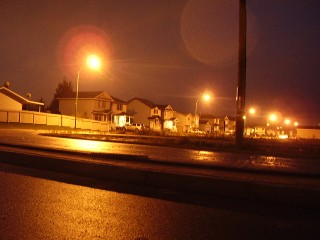
Lights on 36th Street adjoining Hampton Village.
These are standard spacing and high cobrahead fixtures. |
|
|
| The FCOs are the same Envirosmart types used in Calgary neighbourhoods. In effect, this should contribute greatly to the slowing of light pollution growth as Saskatoon expands, and slowly darken the city core. |
|
However,
our joy and optimism is guarded. Despite the acceptance of the pilot project result we do not believe that council has really caught on that lighting for dark skies can help with GHG reduction and preservation of the environment. They also adopted the following recommendations at the same time.
“RECOMMENDATION 2) that cobra head fixtures with drop lens fixtures continue to be utilized for lighting arterial streets and other major thoroughfares; and”,
“RECOMMENDATION 3) that flat lens fixtures not be used as replacements in existing residential neighbourhoods with specialized light fixtures”.
Recommendations 2 worries us, since we do not have a firm definition of what arterial streets and other major thoroughfares are. As a matter of fact, last fall
Light and Power installed unshielded, polluting acorn lamps at double normal density on the feeder road leading into the Hampton Village Dark-Sky Project. This was, of course, done because the moulded glass period fixtures “look good in the daytime”.
|
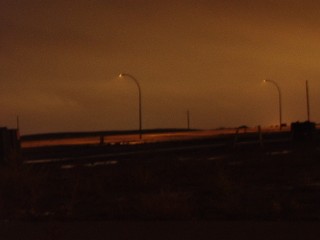
Hampton Village from the same distance as the 36th
Street photo. Note that the lights are barely visible from the side because they produce no sidelight or uplight.
The illumination on the street and sidewalks is the same, though. |
|
|
| Recommendation 3 is also of concern since in the newest Stonebridge subdivision (begun half a year ago) 'specialized fixtures' have been installed which glare and may have some up light.
Nothing really prevents the city from always specifying specialized fixtures in new neighbourhoods and working around Recommendation 1. One other issue with Recommendation 1 is that the City owns only about one-half of the streetlights in Saskatoon. The other half are owned and maintained by SaskPower, who is not bound by Recommendation 1. |
|
| But there is always hope that we can influence better lighting policies for both streetlights and general city and business lighting. Despite these concerns, we have seen some full cut-off lighting appear on Circle Drive and on some new overpasses. However, downtown bridges received unshielded acorns, again for period-style decoration, thus the city continues to use polluting lights to decorate. We certainly have a long way to go before we can say we have made a true impact on the Land of Living Sky, but at least we have a start with the newest neighbourhood policy. |
|
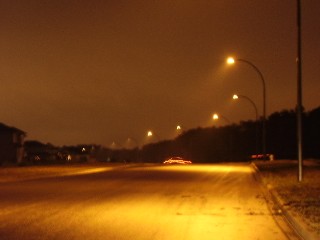 |
The Hampton Village FCOs give very nice patterning on the roadway. The City engineer was worried about the dark areas between the lights, but with the removal of glare from the fixtures, the dark areas are almost completely unnoticed as you drive on the street. Illumination meets IESNA standards. |
|
|
|
